
The Echo in the Machine: A Narrative Introduction
Imagine, for a moment, a dusty recording studio in Mumbai, circa 1952. The air is thick with the scent of jasmine and the tension of a live orchestra. At the center stands a man in a crisp white shirt, possessing a smile that radiates humility. He approaches the microphone, closes his eyes, and releases a note so pure it feels less like sound and more like a prayer. This was Mohammad Rafi.
Fast forward to 2026. We live in an era of silicon and light, where algorithms can simulate almost any human experience. Yet, for the devotee, there is a lingering fear: will the digital noise of the future drown out the velvet echoes of the past?
At RafiFanClub.com, we believe the opposite is true. We are not using technology to replace the Maestro; we are using it to build a cathedral for his voice. This is our manifesto—a commitment to using the most advanced tools of our time to ensure that the man who sang for everyone is finally heard by everyone, everywhere.
I. The Vision: AI as a Curator, Not a Creator
In the current landscape of Artificial Intelligence, a dangerous trend has emerged: the “cloning” of legendary voices. We stand firmly against this. To clone Rafi Saab is to misunderstand him. His genius did not lie in the frequency of his pitch, but in the Ruh (soul) he breathed into every syllable.
To see how we are applying this philosophy across our entire digital archive, explore our central roadmap: AI & The Maestro: Unveiling Mohammad Rafi’s Legacy in the Digital Age.
Why AI Can Curate What Humans Cannot
With a discography spanning thousands of songs across multiple Indian languages and genres, the sheer volume of Rafi Saab’s work is staggering. AI allows us to:
- Hyper-Categorization: Beyond just “Sad” or “Happy,” AI helps us tag songs by specific Ragas, the micro-emotions (e.g., Pathos, Vairagya, Shringar), and even the specific vocal texture he used for different actors like Dilip Kumar or Johnny Walker.
- Pattern Recognition: AI can analyze the “vocal arc” of a song, helping students of music understand how he transitioned from a soft mandra saptak (lower octave) to a soaring taar saptak (higher octave) without a hint of strain.
II. Breaking the Language Barrier: Global Accessibility
One of the greatest tragedies of the Golden Era is that the profound poetry of lyricists like Sahir Ludhianvi and Shakeel Badayuni often remains locked behind a language barrier. For a fan in Paris or New York, a song like “Man Tarpat Hari Darshan Ko Aaj” is beautiful, but its spiritual depth is often lost in translation.
Semantic Translation and the “Poetic Soul”
In 2026, AI translation has moved beyond literal word-swapping. We are utilizing Large Language Models (LLMs) trained on Sufi poetry and Urdu literature to:
- Contextual Meaning: Explain the cultural weight of words like Taqdeer or Falsafa.
- Transliteration: Providing real-time, phonetically accurate lyrics so a non-native speaker can sing along with the correct Talaffuz (pronunciation).
- Cross-Cultural Mapping: Comparing Rafi’s vocal techniques to global icons, helping a fan of Pavarotti understand the operatic range Rafi displayed in songs like “O Duniya Ke Rakhwale.”
III. The Expertise Pillar: Technical Musicality and the “Harkat”
To understand why we must protect the original recordings, one must understand the technical impossibility of replicating Mohammad Rafi.
The Anatomy of a Note
Rafi Saab’s singing was characterized by Harkat and Murki—rapid, intricate musical ornamentations that occur in the blink of an eye.
- The Micro-Tone: While AI operates on discrete data points, Rafi operated in the “spaces between notes.” His ability to slide (Meend) from one note to another was liquid.
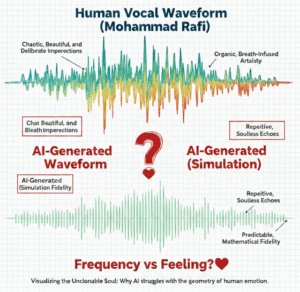
- Vocal Range: He was a rare tenor who could maintain the body of his voice in the highest registers. In 2026, we use AI to visualize these waveforms, not to change them, but to show students the “Vocal Geometry” of his perfection.
 A conceptual diagram comparing the complex human vocal waveform of Mohammad Rafi
with a sterile, repetitive AI-generated simulation, highlighting the ‘Soul Gap’ in digital music.
IV. The Human Pillar: The White Wardrobe and the Yardley Scent
An archivist’s duty is not just to the voice, but to the man. Technology helps us preserve the “Human Interest” stories that make Rafi Saab a North Star for moral conduct.
The Philosophy of White
Rafi Saab was almost always seen in spotless white—a reflection of his internal purity. He believed that the singer should be invisible so that only the song remained. This “White Wardrobe” philosophy is a cornerstone of our archive. It reminds us that in an age of digital flash and “clout,” true greatness is found in simplicity.
V. The Archivist’s Duty: Why 2026 is the Critical Year
Why is the urgency so great in 2026? We are at a tipping point.
- The Physical Decay: Many original magnetic tapes from the 1940s and 50s are reaching the end of their physical life. If they are not cataloged with high-fidelity metadata now, the “context” of these songs may be lost forever.
- The Living Memory: The generation that sat in the recording rooms with him is thinning. We are using AI-assisted oral history tools to transcribe and verify interviews with surviving musicians and assistants, creating a verified “Chain of Custody” for every anecdote.
Preserving the “Golden Era” for the remotest corners
Your mission—and ours—is to ensure that a child in a remote village with a basic smartphone has the same access to the Maestro as a collector in London. By optimizing our archive for Low-Bandwidth AI Search, we make the Golden Era light enough to travel to the “most humble and distant corners of the world.”
VI. Frequently Asked Questions (Voice Search Optimized)
“How many songs did Mohammad Rafi sing?” While numbers vary, our digital archive aims to verify every single recording across 14+ languages, moving beyond the myths to find the documented truth.
“Can AI sing like Mohammad Rafi?” No. AI can mimic a voice, but it cannot mimic the Niyat (intention). Our project focuses on using AI to understand his singing, not to recreate it.
Conclusion: A Shared Moment of Grace
The “Digital Age” does not have to be cold. It does not have to be artificial. When we apply the tools of 2026 to the voice of 1950, we create a bridge. We ensure that the “Divine Voice” doesn’t just survive—it thrives.
We invite you to explore the full, evolving series at our dedicated portal: AI & The Maestro: Unveiling Mohammad Rafi’s Legacy in the Digital Age. As we look at the waveforms of the past through the lens of the future, we find that some things are truly eternal.
Explore the “AI & The Maestro” Series: Next: ➡️ The Soul Gap: Why AI fails the “Rafi Test”
Balwant S. Wadhwani is the founder of RafiFanClub.com.
A lifelong devotee and archivist at heart, he has dedicated his life to sheltering the
echoes of the Golden Era. His singular mission is to ensure Mohammad Rafi’s divine voice
transcends every earthly boundary—traveling to the most humble, distant hearts to
unite all souls, regardless of language, caste, or creed, in a shared moment of
celestial grace.
+~ Balwant S. Wadhwani